
In my early management career, I was told that stakeholder management is one of the most important skills to develop and master. At the time, I did not even know the word stakeholder (English was not very good back then, particularly some colleague in his email wrote stakeholder as steakholder 😂🤣). So what really is stakeholder management?
First, we have to understand what is stakeholder and why even bother to manage them? Stakeholder, simply put, is anybody who has any interest in and affected by your work. And they are at the core of getting your work done. Particularly in management, most of the time, you job is to get things done through others, and you need to know with whom you are dealing with and their positions relative to the work-to-be-done at hand. So the stakeholder management is the process of maintain good relationships with the people who have most impact on your work.
Now comes to the core of it, how to manage the stakeholder effectively. No magic, but simple methodology – Identify, Map, and Manage (or I’d like to call it Engage).
Identify
The key here is to answer two questions: 1) What is the work-of-interest? 2) Who and what interested in/effected by (WIIFM – What’s In It For Me)?
Here you can use tool like xMind (or any other mapping tools at your choice) to identify all the potential stakeholders via RACI (Responsible, Accountable, Consulted, and Informed) matrix
- Responsible for actually getting the work done, e.g. your teams, your business partners, functions, suppliers, …
- Accountable for the outcomes or results of the work, e.g. your boss, executives, …
- Consulted while the work is being created, e.g. advisors, experts, union, governance, …
- Informed along the way as to the progress being achieved, e.g. peer groups, interested parties, …
Be mindful about another role called observer, they are not necessarily part of your stakeholder list but they may derail or sabotage your work.
Once you have identified all your potential stakeholders, you can do another pass to add to/shorten/update the list by asking the following questions or consider the following factors. This validation process is extremely useful to make sure either you did not miss a critical one or you have the right focus and identify the right things at stake:
- Did I miss anybody?
- “Who else might care about/impacted by this?”
- “Who might be surprised by the work if not engaged?”
- Are there too many on the list?
- No harm feelings (FOMO or JOMO)
- Group and prioritize
- Is the stake wrongly identified?
- What stakes of that person is holding? (Decision Maker, Influencer, Curious Parties,…)
- Sometimes the cues can provide you a lot of insights by listening (verbal, what the person has to say about the work to be done) and observing (behavioral, expressions, gesture, etc)
Map
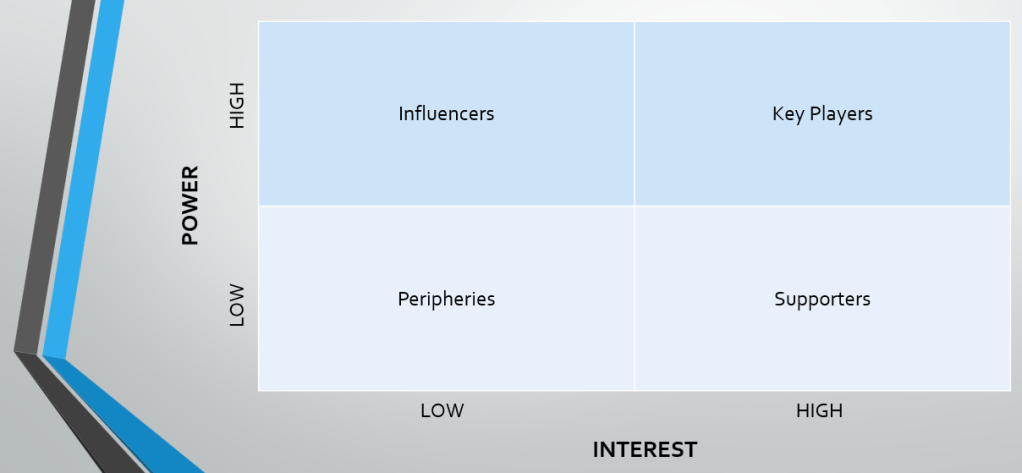
Once you have identified the list of stakeholders of your work-at-stake, you can map them onto a “Power and Interest Matrix” so that you can develop corresponding strategy to manage/engage each category. It is straightforward, Power means how much power that individual has to impact the outcome of your work and Interest means how much interest that individual has about your work. Here you go, four categories, obviously this will also help to prioritize your time investment in each category.
Manage/Engage
Now the hard work, and also the fun part – come up with strategy and go ahead and do it. Building on top of the Power/Interest Matrix you develop in the previous step:

There is one ground truth of any engagement, ready? (I have mentioned this many many times…)
The single desire that every human being has is to be seen, to be heard and to be understood.
This means that with the strategy above, you got to spend time and energy to build the relationships with them. A few tips:
- Establish basics (respect and trust)
- Nurturing (keep it warm and be proactive)
- Constructive
- Listen/Consult/Inform/Influence
And like any relationship, periodically reflect on how it goes (what went well? what did not work? what can be changed to improve?) is essential.
A few more tips…
Lastly, people often asked me some questions particularly given that we are working in technology innovation and delivery:
- How to deal with a stakeholder who is very pushy, and refuses to see your/team’s point of view?
- How to say No (especially to senior management)?
- How to make business stakeholders see that nothing comes for free?
- What are signs that business stakeholders are not in sync, despite they are showing up in required meetings?
- What are the most important activities to organize with business stakeholders?
So here are some of my tips:
Difficult Stakeholder
- Where are they on the mapping and can you ignore them?
- Talk to them, seek to understand first
- “I might be wrong, but I feel such a wall of resistance, what is really going on here?”
- Take the high ground try to remove non-productive emotions
- Guide them to be more-effective behaviors
- Get somebody who has influence on them to talk to them
- Find supporters who has influence on those difficult stakeholders
- Convert every difficult situation to a learning experience
Activities
- Team Building & Socializing
- Know them as person – people first approach is profound…
- Conference & Workshop
- Do something together
- Proactive Sharing
- Keep it lasting… after all, we spend a lot of time at work why not make some friends 😎
 Bin's Blog